
ADHD Research Briefing: August 7, 2026
A 28-year study of 4,128 people found the "ADHD entrepreneur advantage" shows up almost entirely in high-IQ men, while women with ADHD had the lowest business-ownership rate of any group.

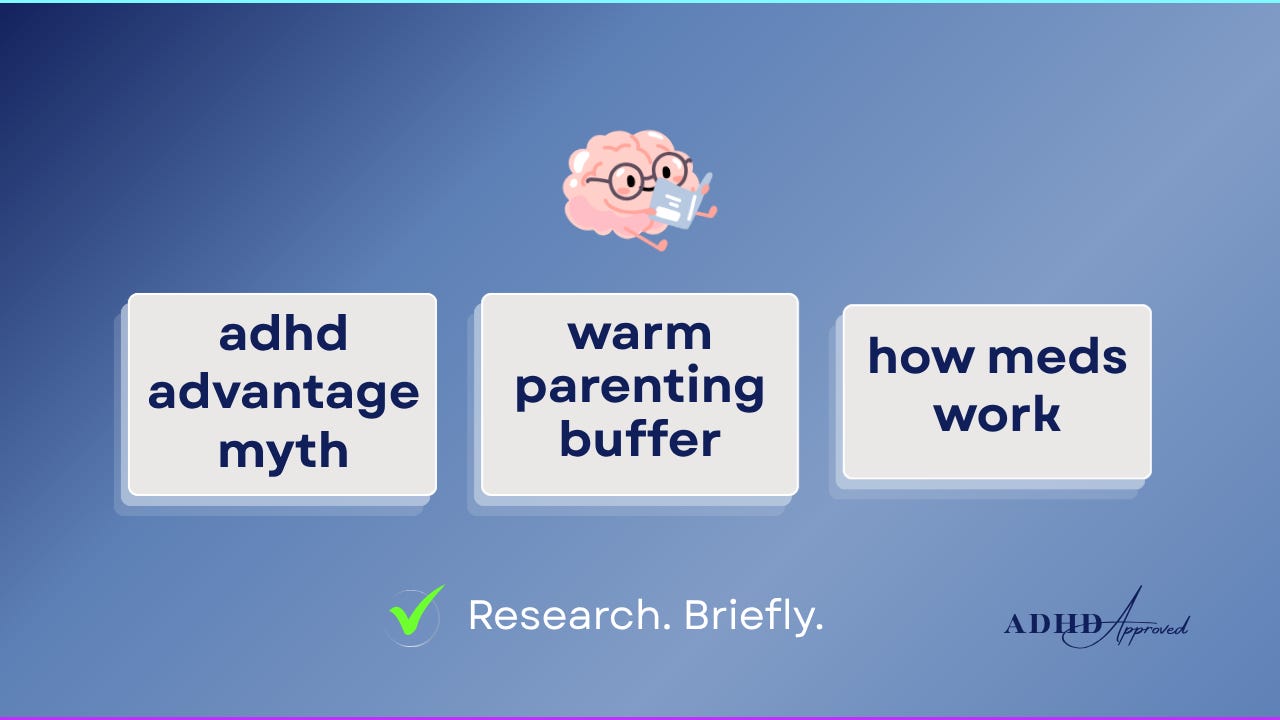
This week’s theme: This week’s research keeps circling one idea: ADHD’s outcomes hinge on context — gender, caregiving, environment — not the diagnosis alone. The headline event is a landmark new medication approval, wrapped around several studies showing the same label plays out very differently depending on who has it and where they live.
The “ADHD entrepreneur advantage” is mostly a high-IQ-men story; women get the opposite.
Across 4,128 people tracked for 28 years, ADHD alone predicted neither more nor less entrepreneurship; the celebrated advantage only appeared in highly intelligent men, while women with ADHD had the lowest business-ownership rate of any group, regardless of intelligence. The split only surfaces once you account for gender and intelligence.
Worth knowing because: the same traits sold as a “tailwind” for men can act as a headwind for women, so measuring yourself against that narrative was never a fair test.
Primary: Applied Psychology
Plain-English Read: PsyPost, Aug 1, 2026
Confidence/label: Moderate (large and long-running, but one US observational cohort analyzing occupational choice)
Warm, responsive early caregiving can absorb a prenatal ADHD risk.
Inflammation during pregnancy predicted more ADHD symptoms in kids at age 3, but only where early caregiving was low in sensitivity; where caregiving was attuned, that prenatal risk basically washed out. Think of responsive caregiving (reading and answering a baby's cues) as a shock absorber over a bumpy prenatal road; single observational cohort of 300+ pregnancies.
Worth knowing because: it frames warm caregiving as a protective lever, not one more thing to master.
Caution: this is one careless sentence away from mom-blame; the authors explicitly say it isn't prescriptive and no parenting is perfect.
Primary: Journal of Child Psychology & Psychiatry
Plain-English Read: OHSU News, July 31, 2026
Confidence: Watch carefully (underlying evidence is moderate; but framing risk is high)
How stimulant medication actually steadies a child's attention
Using second-by-second brain imaging in 31 children (ages 8–12), a team led by FSU's Tehila Nugiel showed methylphenidate works by calming the flickering — reducing rapid, unstable switching between brain networks so regions communicate more steadily, which tracked with better focus.
Worth knowing because: It's a satisfying peek under the hood of a decades-old drug, reframing it as a network stabilizer rather than just a stimulant.
Primary: Translational Psychiatry
Plain-English Read: PsyPost, Aug 6, 2026
Confidence/label: Early (small sample, mechanistic)
FDA approves Simtriyo (centanafadine), the first “triple” ADHD drug
The FDA approved Otsuka’s centanafadine (brand name Simtriyo) on July 24 for adults and kids 6+, the first medication that boosts three brain chemicals at once, norepinephrine, dopamine, and serotonin (think of it as widening three lanes of traffic instead of the usual two). But it’s a brand-new commercial launch, so real-world effectiveness and side-effect patterns are still to be seen.
Worth knowing because: it’s backed by four Phase 3 randomized trials showing symptom improvement as early as week one.
Press Release: Otsuka
Primary: Psychiatric Times
Confidence: Watch carefully
Know someone who needs this? Forward it.
Hype Watch:
ADHD linked to more violence-related ER visits
Analyzing Welsh population records from 2012–2024, Cardiff, Swansea, and York researchers found people with ADHD (and some other conditions) were more likely to turn up at emergency departments due to violence, even after accounting for social and health factors, while an autism diagnosis was linked to lower likelihood. The signal likely reflects people with ADHD more often being harmed or in crisis, pointing to a need for support.
Worth knowing because: this is an association in linked records, so read it as a flag for vulnerability, not proof of cause.
Primary: Emergency Medicine Journal
Plain-English Read: Cardiff University, Aug 4, 2026
On the horizon
Perimenopause research is heating up and the new ADHD-Her study is recruiting women across the lifespan, estrogen’s role in ADHD symptoms is shaping up to be a story to follow.
Study details: CADDRA
Scope note
All items were checked against their reporting source and, where reachable, the underlying journal. Screening tools and cross-sectional designs are flagged because they show associations, not proof of cause. This briefing is informational and not medical advice.
On confidence
Strong = meta-analysis, large longitudinal study, or replicated finding;
Moderate = solid but narrower or observational;
Early = new, small, or preliminary;
Watch carefully = controversial, pregnancy- or treatment-adjacent, or commercially promoted. Each item carries one label.
➤ Browse every briefing
Keep reading
You're Not Behind. You're Rebuilding Under Pressure.

If you’re somewhere in your forties (or approaching) and starting to wonder why the systems that carried you for twenty years suddenly stopped holding, you’re in good company. This piece is for you.
Why Women With ADHD Burn Out at Work (The Load-Bearing Wall)

You’re great at your job. You’re the one people trust, the plate-spinner, the fixer, the one who always pulls it off. But the one week you try to pull back for a much-deserved vacation, everything wobbles. Deadlines slip. Work bottlenecks. Small fires start. A dozen people suddenly have “just a quick question.” You get pulled back in like gravity.
Further reading:
ADHD & Sleep | Research Briefing
Connect:
About Me | Bluesky | 🥤 Buy Me A Coffee | Facebook | Instagram | YouTube
The research referenced in this article is intended for informational purposes only and does not constitute medical advice. Always consult a qualified healthcare provider for diagnosis or treatment.