
ADHD Research Briefing: Week of July 17–24, 2026
1,414 adults with ADHD, 76% with insomnia, and one shared predictor that has nothing to do with your bedtime routine. Plus the one shift worth trying tonight.

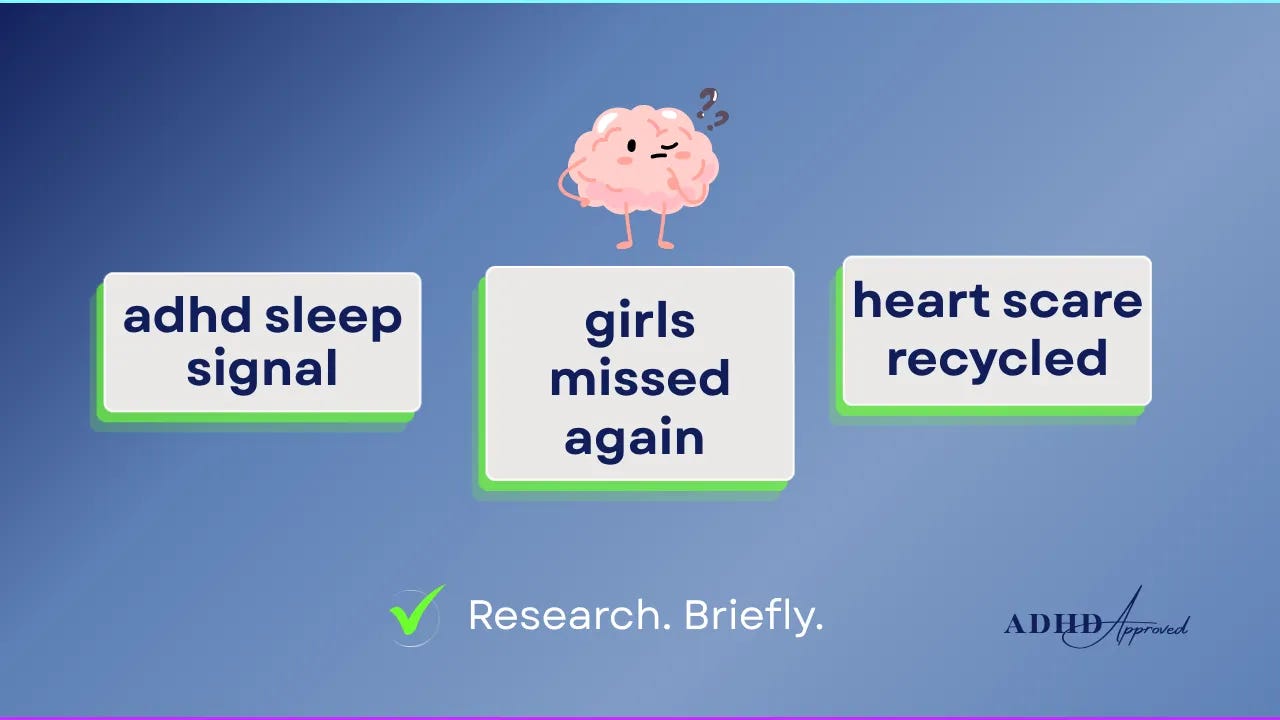
This week’s theme: The research spotlight landed on everyday life — sleep, screens, and how people actually use their meds — rather than on brain wiring. Think of it as studying the weather ADHD lives in, not the climate it's born with. Plus, new drug: centanafadine is on the horizon.
When emotions are hard to manage, sleep pays the price (a mostly-female sample)
In a study of 1,414 adults with ADHD — 81% of them women — the people who struggled most to steer their emotions were the ones most likely to report insomnia. Emotional distress keeps the body in hyperarousal at bedtime, so the shutdown signal never fires. Being a night owl did not explain it, and neither did depression or medication status. Picture a car with no brakes: feelings keep rolling at night and won’t let the mind park.
Worth knowing because: it points to emotional coping as a lever worth pulling when someone with ADHD can’t sleep, especially younger adults and women, who are underrepresented in most ADHD research.
Primary: Journal of Affective Disorders
Plain-English read: Adults with ADHD who struggle to manage emotions face a higher insomnia risk
Confidence: Moderate (cross-sectional, self-report, self-reported diagnosis)
Further Reading: ADHD & Sleep
Girls may have been missed again — because parents were doing the rating
Across 11,286 adolescents followed five years in the ABCD study, a rise in addictive-quality use at 14 or 15 predicted more parent-reported ADHD symptoms a year later. The reverse pattern was much weaker and inconsistent: higher ADHD symptoms did not reliably predict more addictive-quality social media use the following year. What mattered was the loss of control, not hours logged.
Worth knowing because: ADHD symptoms here were rated by parents, and parents are the exact group that has historically missed ADHD in daughters, so "no effect in girls" and "nobody saw it in girls" are not distinguishable in this design.
Primary: JAMA Network, July 2026
Plain English version: Washington Post
Confidence: Strong (large longitudinal cohort, within-person modeling, but observational)
Misuse of ADHD stimulants among adults under 30 fell by half, from 7.5% in 2016 to 3.7% in 2023.
First mention: ADHD Research Briefing: Week of July 10–17, 2026
A rapid review of 64 studies found misuse of ADHD stimulants like Adderall roughly halved among adults under 30 — from about 7.5% in 2016 to 3.7% in 2023 — and has held steady since. Part of the drop likely traces to the 2022 shortage, when nearly 72% of patients struggled to fill a prescription, which is a bleak way to earn a good statistic.
Worth knowing because: Encouragingly, the same review found no sign that taking prescribed ADHD medication as a teen raises the risk of later substance abuse.
Primary: Journal of Clinical Psychopharmacology
Press Release: Keck School of Medicine of USC, July 9, 2026
Confidence: Moderate
Know someone who needs this? Forward it.
Hype Watch:
Health warning issued about ADHD medication as number diagnosed in last year surges
No new research at all. A UK tabloid cycle built on a 2021 cohort study and a 2022 Swedish study, run through a Daily Mail piece, pegged to a charity campaigning for pre-treatment ECGs on the NHS. The headline reads like a regulator issued something. Nobody did.
LAD Bible, July 2026
Counterweight: the six-region meta-analysis across millions of participants finding no significant association between ADHD medication and cardiovascular disease.
ADHD Evidence Project, April 2024
Confidence: Watch carefully
On the horizon
The FDA's decision deadline on centanafadine, a first-in-class non-stimulant, is today, July 24, 2026.
Centanafadine, an experimental non-stimulant that nudges three brain chemicals at once (norepinephrine, dopamine, serotonin), is up for an FDA decision on July 24, 2026. New follow-up analyses of its Phase 3 trials in ~744 adults suggest it helps not just core symptoms but also executive function — think time management, planning, starting and finishing tasks — plus emotional regulation.
Read with caution: these are post-hoc looks (analyses run after the fact), not the trial’s main scorecard, and they come from the drug’s maker.
Primary: Psychiatric Times
Scope note
All items were checked against their reporting source and, where reachable, the underlying journal. Screening tools and cross-sectional designs are flagged because they show associations, not proof of cause. This briefing is informational and not medical advice.
On confidence
Strong = meta-analysis, large longitudinal study, or replicated finding;
Moderate = solid but narrower or observational;
Early = new, small, or preliminary;
Watch carefully = controversial, pregnancy- or treatment-adjacent, or commercially promoted. Each item carries one label.
➤ Browse every briefing
Keep reading
DSPS or Night Owl? When a Late Chronotype Becomes a Disorder in Women With ADHD

If you can’t fall asleep “on time” no matter how tired you are, but sleep deeply once you finally drift off, that pattern has a name. It’s more than simply being a night owl. A night owl chooses late hours and could shift them with little effort. Delayed Sleep Phase Syndrome (DSPS) is a circadian rhythm sleep-wake disorder: the body’s internal clock is …
She Wasn't Too Sensitive. Her Nervous System Was Already Learning to Hide.

She held it together all day at school. She was polite, agreeable, helpful. Nobody sent home a note.
Further reading:
ADHD & Sleep | Research Briefing
Connect:
About Me | Bluesky | 🥤 Buy Me A Coffee | Facebook | Instagram | YouTube
The research referenced in this article is intended for informational purposes only and does not constitute medical advice. Always consult a qualified healthcare provider for diagnosis or treatment.