
ADHD Research Briefing: Week of July 10–17, 2026
Girls diagnosed with ADHD carry a heavier health load into adulthood, and no one connected it to their brains until now.
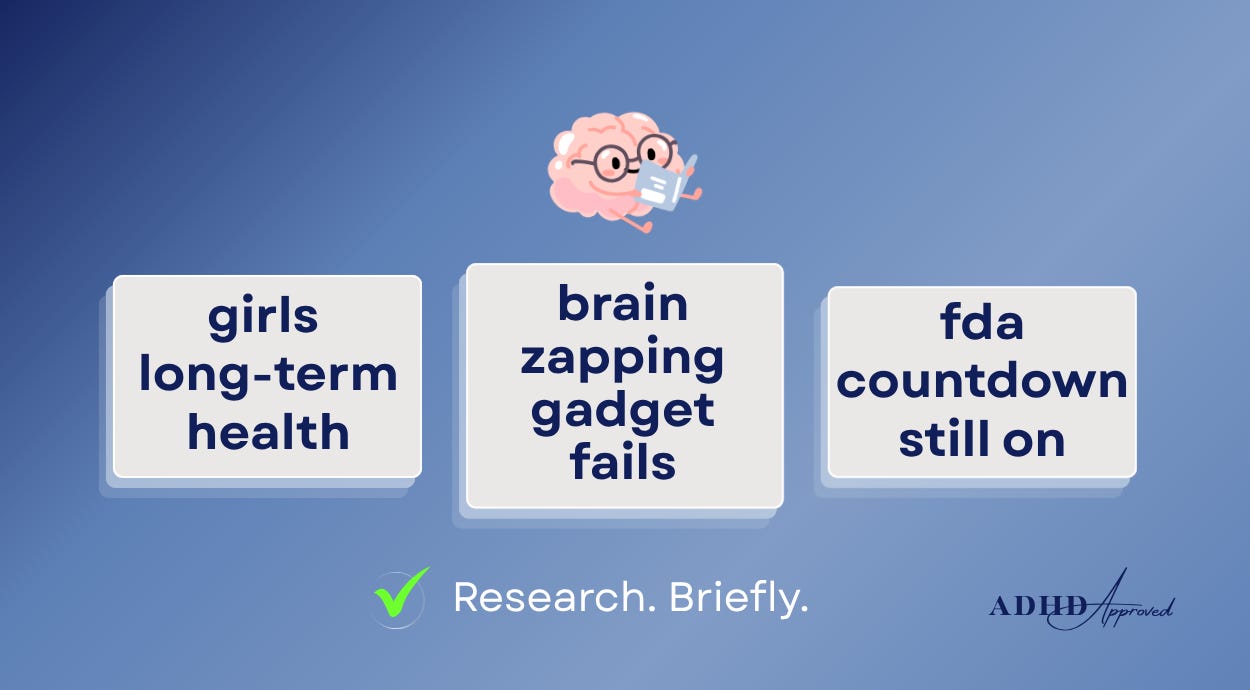
This week's theme: The freshest, most solid news is a set of treatment reality-checks — one thing that clearly doesn't work, one new drug at the FDA's door, and a big pregnancy-safety reversal — while genuinely new research focused specifically on women and girls was thin this week (the strongest women-and-girls item is a few weeks old and flagged as such below).
Stimulant misuse among U.S. adults is dropping — but a shortage may be why
A rapid review of 64 studies found misuse of ADHD stimulants like Adderall roughly halved among adults under 30 — from about 7.5% in 2016 to 3.7% in 2023 — and has held steady since. The catch: the drop lines up with the national stimulant shortage that started in 2022, when most patients struggled to fill prescriptions, so “less misuse” may partly reflect “less available.”
Worth knowing because: Encouragingly, the same review found no sign that taking prescribed ADHD medication as a teen raises the risk of later substance abuse.
Primary: Journal of Clinical Psychopharmacology
Press Release: Keck School of Medicine of USC, July 9, 2026
Confidence: Moderate
Brain-zapping gadgets don’t move the needle on ADHD
Pooling seven trials of about 300 people, researchers found that tDCS — a wearable device that runs a gentle electrical current across the forehead to “wake up” the brain’s control center — did no better than a fake, switched-off version. Neither focus, hyperactivity, working memory, nor impulse control improved.
Worth knowing because: these devices are marketed to families as a drug-free fix, and this is the clearest signal yet that, for now, the science isn’t there.
Primary: Frontiers in Psychiatry
Plain-English read: The ADHD Evidence Project, July 2, 2026
Confidence: Strong
ADHD and autism may leave opposite “fingerprints” in the immune system
A new analysis reports that autism tends to come with elevated inflammatory signals in the blood, while ADHD tends to come with lower ones — like two conditions leaving mirror-image marks.
Worth knowing because: If it holds up, it hints that these overlapping diagnoses may have genuinely different biology under the hood. It’s early and preliminary, though — a pattern to file away, not a test you’ll see at the doctor’s office anytime soon.
Primary: European Child Adolescent Psychiatry (2026)
Plain-English read: Psychiatry Advisor
Confidence: Early
Not New, Still Relevant
Girls with childhood ADHD carry a heavier adult health load — poverty piles it on
Published ~May 2026
Following a large group of women born in Wales and tracking their health records into their early 30s, researchers found girls diagnosed with ADHD in childhood were more than twice as likely to develop several long-term health conditions at once as adults. When childhood poverty was also in the picture, the two stacked like weights on the same scale — roughly 39% of the extra health burden came from ADHD and deprivation combined.
Worth knowing because: It’s a reminder that ADHD in girls is a whole-body, whole-life issue, not just a school-years attention problem.
Primary: Nature Mental Health
Plain-English Read: Medical Express
Confidence: Strong
Know someone who needs this? Forward it.
Hype Watch:
Tylenol in pregnancy cleared of ADHD and autism link in a huge sibling study
Comparing siblings from the same mother — one exposed to acetaminophen (Tylenol/paracetamol) in the womb, one not — researchers found no increased risk of ADHD or autism, across every trimester, dose, and usage pattern. The sibling design is the clever part: it cancels out shared family genetics and home life, suggesting earlier “links” were really about the mother’s underlying health, not the pill.
Worth knowing because: Given the recent public claims tying Tylenol to autism, this is a large, well-built counterweight worth watching as it’s debated.
Primary: JAMA Internal Medicine
Press Release: Aston University, June 2026
Confidence: Watch carefully
On the horizon
A new non-stimulant heads to the FDA — decision due July 24
Centanafadine, an experimental non-stimulant that nudges three brain chemicals at once (norepinephrine, dopamine, serotonin), is up for an FDA decision on July 24, 2026. New follow-up analyses of its Phase 3 trials in ~744 adults suggest it helps not just core symptoms but also executive function — think time management, planning, starting and finishing tasks — plus emotional regulation.
Read with caution: these are post-hoc looks (analyses run after the fact), not the trial’s main scorecard, and they come from the drug’s maker.
Primary: Psychiatric Times
Scope note
This was a quiet week for brand-new peer-reviewed research on ADHD in women and girls specifically. Rather than pad the list, the briefing surfaces the most substantive verified items available and flags the one older-but-important women-and-girls study.
On confidence
Strong = meta-analysis, large longitudinal study, or replicated finding;
Moderate = solid but narrower or observational;
Early = new, small, or preliminary;
Watch carefully = controversial, pregnancy- or treatment-adjacent, or commercially promoted. Each item carries one label.
Keep reading
DSPS or Night Owl? When a Late Chronotype Becomes a Disorder in Women With ADHD

If you can’t fall asleep “on time” no matter how tired you are, but sleep deeply once you finally drift off, that pattern has a name. It’s more than simply being a night owl. A night owl chooses late hours and could shift them with little effort. Delayed Sleep Phase Syndrome (DSPS) is a circadian rhythm sleep-wake disorder: the body’s internal clock is …
You're Not Behind. You're Rebuilding Under Pressure.

If you’re somewhere in your forties (or approaching) and starting to wonder why the systems that carried you for twenty years suddenly stopped holding, you’re in good company. This piece is for you.
Further reading:
ADHD & Sleep | Research Briefing
Connect:
About Me | Bluesky | Facebook | Instagram | Pinterest | YouTube
The research referenced in this article is intended for informational purposes only and does not constitute medical advice. Always consult a qualified healthcare provider for diagnosis or treatment.