
Why ADHD Brains Say Yes When They Mean No (And How to Stop)
If you've ever tried to just say no and watched it fail anyway, this is why willpower isn't the problem, and what actually helps.

There’s a particular quality to the moment of watching yourself agree to something you didn’t want to agree to. It doesn’t feel like a decision. It feels like catching a scene from the outside, registering what’s happening a half-second too late to intervene.
If you’ve ever come away from a conversation thinking: why did I say that, the answer isn’t weakness or spinelessness or a confidence deficit. The automatic yes has a neurological address, and it’s not in the part of your brain that makes considered decisions.
(The full mechanism behind this lives in the first piece in this series. It's worth reading in order.)
This article is about what comes after understanding the mechanism. What changes, what doesn’t, and what one small structural shift can actually do.

What the explanation changes
When people-pleasing is understood as a personality trait, the improvement framework makes a certain kind of sense: build confidence, set firmer limits, practice saying no. The intervention targets the character. It misses the mechanism entirely and it has nothing to offer when executive function is already depleted from fatigue or overwhelm.
When people-pleasing is understood as a suppression-driven nervous system response, the character-based framework stops working. Not because the desire for change isn’t real, but because you can’t shame your way out of a nervous system response. You can’t willpower past a reflex that fires before the reasoning brain arrives.
What the explanation changes isn’t the pattern itself, not immediately. It changes what you’re working with. It shifts the intervention target from character to mechanism. That switch matters enormously, because mechanism-level problems require mechanism-level tools.
It also changes how you speak to yourself about it. The woman who sees herself as a pushover is trying to fix something that feels like a flaw. The woman who understands her nervous system’s default is working with a physiological pattern that has a history and a logic. These are different experiences of the same situation. One is considerably kinder, and considerably more accurate.
You can’t shame your way out of a nervous system response.
Why standard advice fails here
‘Just say no’ is good advice for a brain that is making a considered decision in real time.
The ADHD nervous system, under social pressure, is making a knee-jerk decision. The suppression reflex has already fired. The emotional amplification has already registered the social stakes as high. By the time ‘just say no’ arrives as an available option, the yes is often already out the door.
While this feels like a willpower failure, it’s actually a timing problem. The advice targets the wrong moment. The considered brain hasn't arrived yet.
This is also why trying harder, more rehearsing, more intention-setting, more affirmations, often don’t produce lasting change with this specific pattern. The effort is real. The target is wrong. What works isn't rehearsing a different emotional response. It's rehearsing the exit from the moment before it arrives.
Rehearse the exit, not the emotion.
Willpower applied at the wrong moment is still the wrong tool. The fix has to happen before the trigger, not during it.
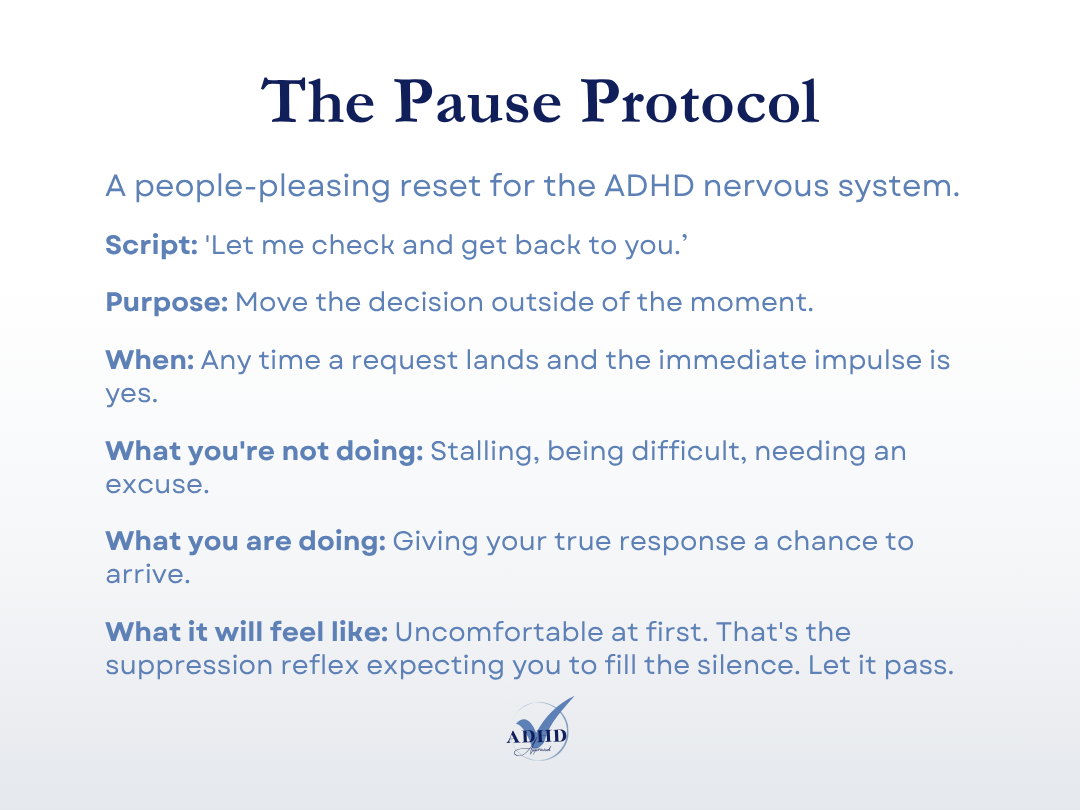
The Pause Protocol
Here’s what that looks like in practice.
The Tool:
This tool is simple. Almost to the point of feeling insufficient. The goal here is small and specific: create one structural pause between the social trigger and the response.
The script: ‘Let me check and get back to you.’
Even when there’s nothing to check. Even when the answer is probably yes. Even when you feel the social pull to respond immediately.
This isn’t a trick or a deflection. It’s a bridge built in advance, for a moment when the nervous system is activated and the considered brain is still catching up. The pause moves the decision to a later moment, outside the immediate social context, when the suppression reflex has had time to settle and the actual considered response has room to form.
The Practice:
In person: ‘Let me check my calendar’ or ‘Let me think on that and get back to you.’ work beautifully. Warm, unhurried, nothing to explain.
By text or email: ‘I want to give this a proper answer, let me get back to you shortly.’ Closing the thread until the nervous system has settled.
In professional contexts: ‘I’d like to look at my current commitments before I confirm.’ Entirely unremarkable.
The goal in every version is the same: move the decision point to a moment when you have access to what you actually want to say.
What ‘good enough’ looks like
The goal is not to become someone who never people-pleases.
The nervous system that was sensitized across years of social correction will not be redesigned by a pause script. The suppression default will still fire. The amplification will still happen. The autonomic cost of years of masking doesn’t disappear because you have a framework for understanding it.
What changes is smaller and more real: one decision, moved outside the suppression window. One moment of choice that wasn’t available before. Over time, with repetition, the pause becomes more accessible, and more automatic, than the immediate yes.
That’s the whole win. Not a new personality. Not a fixed nervous system. One small nudge that gives the considered brain a seat at the table it kept missing.
One way to hold this
Understanding that this started as a nervous system trying, reasonably and accurately, to protect you from pain it had learned was coming, doesn’t erase the pattern. But it does remove the layer of shame that has been sitting on top of it.
You’re now more informed about the mechanism and have permission to gently set down any urge to people-please. This is a different thing, and a kinder one.
Pick one recurring request type where you consistently say yes before you’re ready. One context, not all of them. Practice the pause script there this week. That’s the whole assignment. The goal here is to build the muscle of pausing before responding.
*Worth trying: Listen to how others delay or decline. Borrow those phrases.
Something to Sit With
What would it feel like to give yourself one week where ‘let me get back to you’ was always available as an answer?
Where this started
The Pause Protocol only makes sense once you understand what it’s pausing for.
Part 1 of this series covers the neurological chain behind your automatic yes: the amplification, the suppression reflex, the years of sensitization, and the autonomic cost that doesn’t lift with rest.
The Yes You Watched Yourself Say

ADHD people-pleasing is driven by four neurological factors: emotional amplification that fires too fast, a suppression reflex that engages before reasoning, a nervous system sensitized by years of social correction, and an autonomic cost that accumulates silently in the body.
Further Reading:
ADHD & Sleep | Research Briefing
Connect:
About Me | Bluesky | Facebook | Instagram | Pinterest | YouTube
The research referenced in this article is intended for informational purposes only and does not constitute medical advice. Always consult a qualified healthcare provider for diagnosis or treatment.
ADHD presents differently for everyone. What resonates here may not reflect every experience.
And that’s okay.
Liu et al., 2022, Journal of Affective Disorders
Attoe & Climie, 2023, Journal of Attention Disorders
Rowney-Smith et al., 2026, PLOS One
Soler-Gutiérrez et al., 2023, PLOS One
Bellato, A. et al., 2020, Neuroscience & Biobehavioral Reviews