

You were fine before.
Maybe not perfect. You’ve always been a little scattered, always left things to the last minute, maybe had that nagging feeling you were running on fumes that nobody else could see. But you were fine. You held a job, kept friends, paid bills, got things done. Even took vacations.
Then you had the baby. And now, somehow, you just…. can’t.
Not reliably. Not consistently. Not in the way that used to feel automatic, though not necessarily easy. Your systems that kept everything running, the one you didn’t even know you were using, have stopped working. Your hacks have collapsed.
And nobody around you seems to understand why your strategies imploded so completely or that they’ll never quite work like they once did. Yourself included.
You might have ADHD. And it’s possible you’ve had it your whole life.
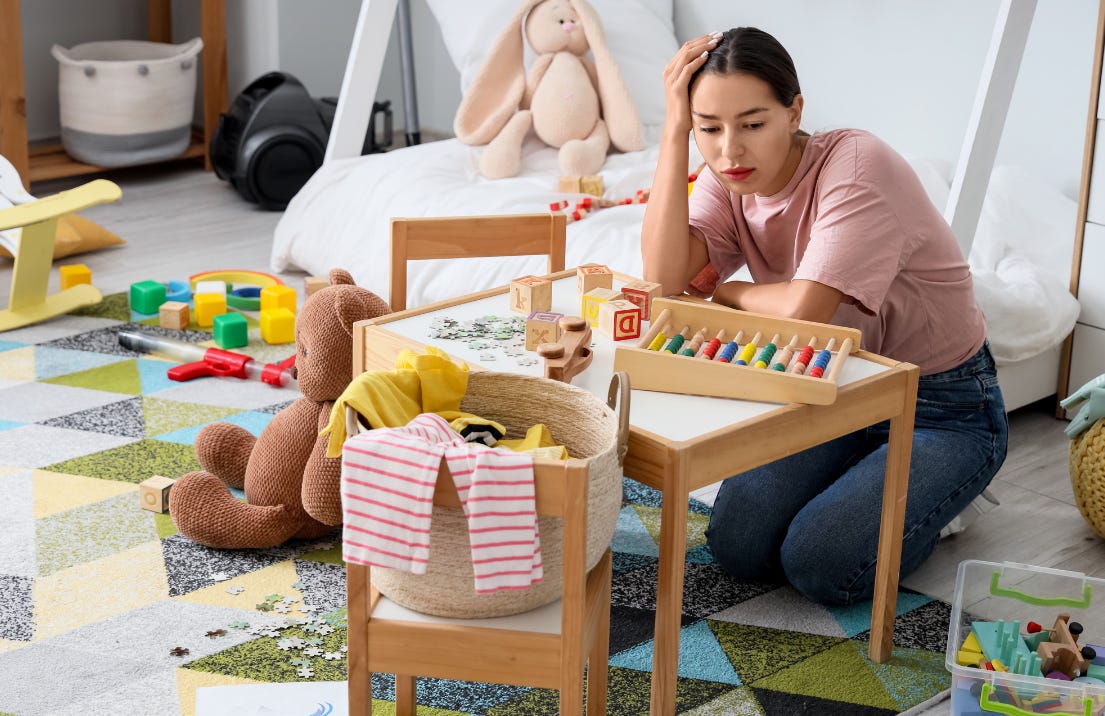
Before kids, you had systems
Many women with ADHD develop what researchers call “masking”. Not a conscious choice, but a layered set of compensating strategies that develop over years starting in early girlhood.
Structure helped. School, maybe even college, and a demanding job gave your brain the external scaffolding it needed. A predictable schedule meant fewer decisions. Sleep was something you could actually get. And the demands on your executive function, while real, were mostly things you worked around.
None of those strategies disappeared when you had a child. But the environment where they worked did.
Something unique to moms with ADHD is happening here, and understanding it changes how you view the results of your good faith effort.
What happened in your brain after childbirth
Estrogen isn't just a reproductive hormone. It actively supports the dopamine system in your prefrontal cortex, the region responsible for attention, working memory, and starting tasks. Low-estrogen environments are most consistently linked to worsening ADHD symptoms in women.1
The mechanism: estrogen is needed for dopamine synthesis and receptor activity in the basal ganglia and prefrontal cortex, both regions already implicated in ADHD.
Postpartum is one of the steepest estrogen drops a body experiences. Ever.
For a neurotypical brain, that drop is hard. For an ADHD brain, which already has a different relationship with dopamine, the drop lands on top of an existing deficit. There’s less buffer to absorb it.
At the same time, the demands on your executive function increase tremendously.
Feeding schedules. Sleep deprivation. Sensory overload. Managing another human’s entire nervous system. Emotional regulation when you haven’t slept. Rapid and constant task-switching with no break.
Hormonal transitions including pregnancy and postpartum exacerbate ADHD symptoms and mood disturbances specifically because the ADHD nervous system has fewer resources to adapt.2
Simply put, your executive load exceeds what strategies and masking can compensate for.
Why it looks like depression or anxiety
Women with ADHD are significantly more likely to receive a diagnosis of depression or anxiety in the postpartum period, independent of prior psychiatric history, sociodemographic factors, and family history. In fact, roughly 25% of women with ADHD received a postpartum anxiety diagnosis, that’s more than 5 times more likely compared to women without ADHD.3
The anxiety and depression are real. But for many women, they’re happening on top of an ADHD that no one’s identified yet.
Complicating this further is that women with ADHD wait four years longer than men to receive a diagnosis, despite having equal or greater contact with mental health services before that point. And, they’re more likely to be prescribed medication for other conditions, including anxiety and depression, before anyone even considers ADHD.4
If you’ve been treated for anxiety or depression and feel like the treatment is only partially working, ADHD could be worth exploring.
One small thing to try
The worst thing you can do when your brain’s working memory is operating on less than it needs is… rely on it more.
The mechanism: postpartum estrogen drop reduces dopamine support, which directly affects working memory.
The real-world impact: you forget what you were doing mid-task, you can’t start things even when you want to, emotional regulation is elusive, no amount of rest (even if you do get it) seems to help.
One tool that follows from this:
Pick one category of daily life that currently lives mostly in your head, feeding schedules, nap times, appointment tracking, laundry, whatever it is.
Write it down somewhere visible and fixed. Not in your phone. On a wall, a whiteboard, the fridge.
If possible, hand that category to someone else entirely. Not temporarily. For the season you’re in.
This tool is not ground breaking and the goal isn’t optimization. This is just one of many small changes you can make to have fewer open loops competing for limited resources.
What this really means
If you were managing before kids and can’t manage now, you’re not weaker than you used to be. And, you’re not already failing as a mom. Your old strategies simply weren’t built for your current conditions.
Women with late-diagnosed ADHD consistently describe the diagnosis as revelatory.5 Not because it changes who they are, but because something is finally explaining why her life looks the way it does.
Understanding the mechanism is the first step to working with it.
Further Reading:
ADHD & Sleep | Research Briefing
Connect:
About Me | Bluesky | Facebook | Instagram | Pinterest | YouTube
The research referenced in this article is intended for informational purposes only and does not constitute medical advice. Always consult a qualified healthcare provider for diagnosis or treatment.
ADHD presents differently for everyone. What resonates here may not reflect every experience.
And that’s okay.
Osianlis et al., 2025, Journal of Attention Disorders
Kooij et al, 2025, Frontiers in Global Women’s Health
Andersson et al, 2023, Journal of Affective Disorders
Skoglund et al., 2024, Journal of Child Psychology and Psychiatry
Holden, E., & Kobayashi-Wood, H., 2025, Scientific Reports
The 'later' always arrives at bedtime. That's when the waiting is hardest to explain away. Freddie has found the slow shrinking is loudest in the quiet.