
Why Bins Become Black Holes
The real reason things disappear when you put them away

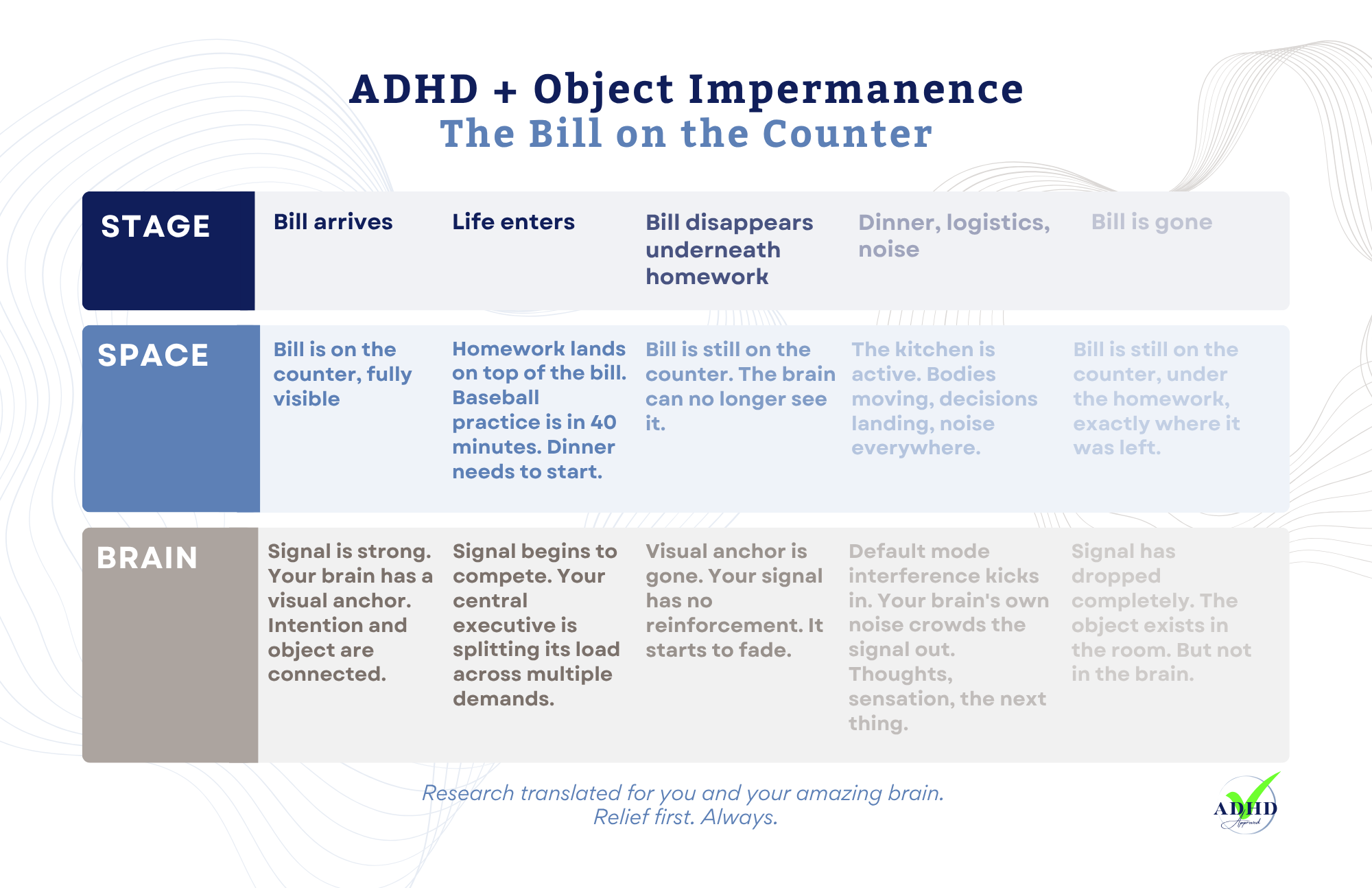
The bill is on the counter. You see it. You think: I need to deal with that today. Then someone asks you something, and you walk into the next room. By the time you sit down, the bill has disappeared. Not from the counter, from your mind. Entirely. In fact, you won’t think about it again until you open a notice two weeks later.
Oops.
Putting things away is one of the worst things an ADHD brain can do. Not because organization is bad. Because for a brain with ADHD, “away” and “gone” are neurologically almost the same thing. Something is dropping. Not your attention, exactly, and not your intention. Something quieter than both, the thread that keeps an object tethered to the part of you that cares about it.

Your brain is not broken. Its signal just fades.
Working memory is the quiet hum running in the background of your day. It’s what keeps the bill on the counter connected to the intention you formed about it an hour ago. For most brains, that signal holds. It dims a little when attention moves, but it doesn’t drop entirely.
For your ADHD brain, the signal is genuinely weaker and fades faster. Adults with ADHD show significant impairments across all three components: verbal memory, spatial memory, and the central executive, the system responsible for sustaining that background hum while you’re occupied with something else.1
Your central executive is the one most severely affected in ADHD.2 It’s the one in charge of keeping a task alive in your awareness once the visual anchor for it has disappeared.
When you set the bill down and walk away, you’re asking a weak signal to carry that information forward without reinforcement. For most ADHD brains, it simply doesn’t make it. But knowing the signal fades doesn’t fully explain what triggers the drop. There is a specific moment, a physical, ordinary moment, when the connection breaks. And it happens dozens of times a day in every room of your house.
When you close the drawer, the task dissolves
You put the permission slip in the folder. The folder goes on the shelf. The shelf disappears behind the cabinet door. By noon, the permission slip has ceased to exist in your world, not because you stopped caring, but because there is nothing left in your environment sending a signal that it’s there.
This isn’t ordinary forgetfulness, it’s a structural gap in how the ADHD brain sustains awareness across time and space. The object is real and present. The signal connecting you to it is gone.
Environmental structure and visual salience directly affect how severely working memory deficits affect functioning.3 When the environment provides immediate, visible cues, deficits are partially offset. When it doesn’t though, when things are closed away, stacked out of view, tidied into opacity, deficits deepen.
The environment, in other words, is never neutral. It’s either carrying part of the signal, or it is asking an already-strained system to carry it alone. And that would be the whole story, if the environment were the only thing working against the signal. It’s not. There’s a second source of interference, and this one is coming from inside.
There is also internal static
Most explanations of ADHD and working memory stop at the fading signal. But there’s something else making it harder to hold on to.
In 2024, Lui et al. described a phenomenon called default mode network interference.4 The brain’s resting state, the internal network of thought, memory, and self-reflection that hums along when attention is unfocused, is supposed to quiet down when you turn your attention outward. In ADHD brains, it doesn’t quiet down as reliably.
While working memory is already struggling to hold the thought of the bill on the counter the brain’s interior, a half-formed memory, a passing sensation, something unrelated and uninvited, drifts across that same narrow frequency and drowns it out.
So the task doesn’t simply fade, it gets crowded out by the brain’s own restless weather. Two forces, then: a signal that fades on its own, and a brain that generates its own static. That is a real structural disadvantage, and it points directly toward what actually helps.
Let the environment carry the signal
Your environment directly affects how well your brain can function with visible cues giving your signal something to hold onto. This is why the solution for object permanence in ADHD is rarely a new organizational method. It’s visibility. The environment is asked to do the remembering because the brain cannot sustain that signal on its own.
What this looks like in practice is less about systems and more about light and openness. Clear containers instead of opaque ones, so contents stay in view. Open shelving for anything requiring action, rather than cabinets or drawers that close things away. A single designated surface, always visible, never buried, for mail, forms, and anything waiting for a response. Labels facing outward rather than tucked inside.
These aren’t aesthetic choices. These are the external signal system the ADHD brain genuinely needs to function. You aren’t failing to remember. You’ve just been working without enough reinforcement.
The point is not to build a better system. It’s to stop asking a strained signal to travel so far without support.
The bottom line
When objects disappear from view, the ADHD brain loses its external anchor and has no reliable internal system to compensate. Visibility isn’t a preference or a style choice. It’s the mechanism. And it’s the one thing most home organization advice forgets to mention.
Further Reading:
ADHD & Executive Function | Research Briefing
Connect:
About Me | Bluesky | 🥤 Buy Me A Coffee | Facebook | Instagram | Pinterest | YouTube
The research referenced in this article is intended for informational purposes only and does not constitute medical advice. Always consult a qualified healthcare provider for diagnosis or treatment.
ADHD presents differently for everyone. What resonates here may not reflect every experience.
And that’s okay.
Alderson et al., 2013, Neuropsychology
Kasper et al., 2012, Clinical Psychology Review
I hear you. After doing it for a while you realize that instant opening it feels sooo good. 🧘🏻♀️
This totally resonate. If I don't do something instantly, or I can't see the bigger picture of all my task, I know I'm going to have a hard time finding the motivation to tackle them. That's why I am constantly building nervous system-friendly dashboards and apps for myself for my ADHD brain. Because you know... out of sight, out of mind!