
Why Time Feels Different When You Have ADHD
The neuroscience behind time blindness, and what to do when the clock stops making sense.

You’ve said it so many times it almost doesn’t feel true anymore:
“I’m sorry. I lost track of time.”
But you meant it every time. And it happened again anyway.
Here’s what no one told you: losing track of time isn’t a habit you can discipline away.
It’s a clock problem. And it has a name: Temporal Myopia1, better known as Time Blindness.
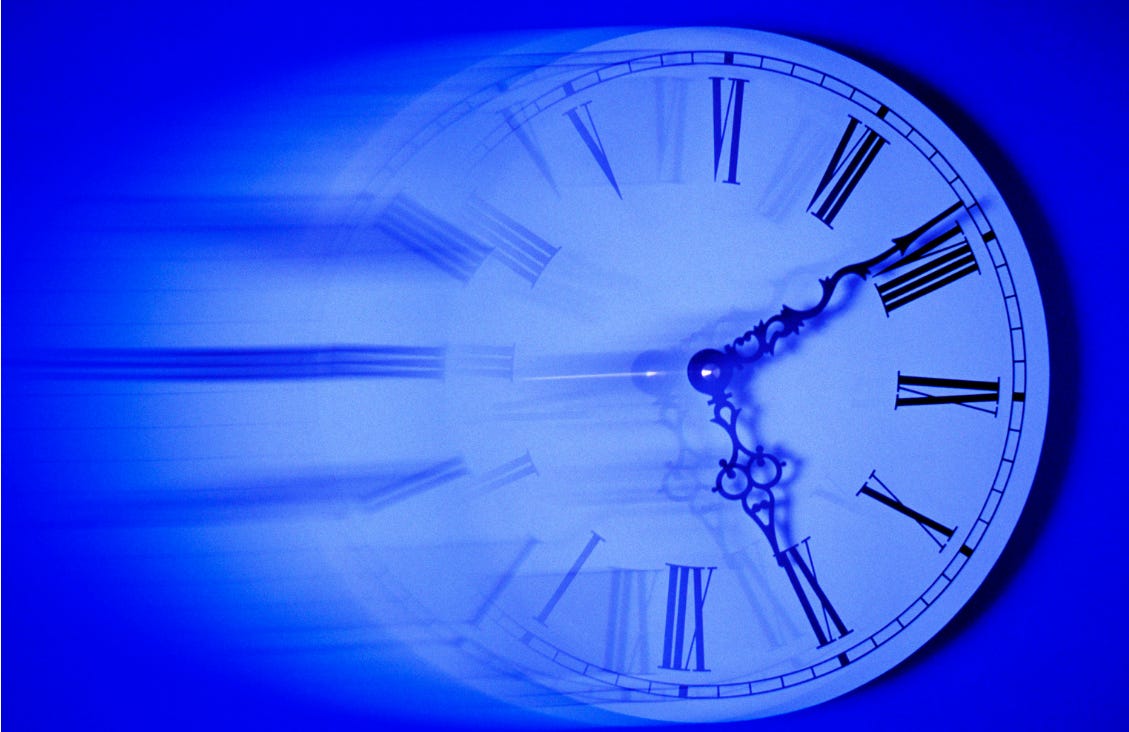
The faulty signal
Think of time perception as a GPS system. For most brains, it runs continuously in the background, tracking where you are in the day, how long you’ve been driving, how far the destination is. It updates without conscious effort.
In the ADHD brain, that GPS has a faulty signal. Three overlapping problems create the gap.
The internal clock problem.
The ADHD brain’s internal pacemaker runs inconsistently. Research reveals evidence of an accelerated internal clock, meaning time subjectively races past without generating a matching sense of urgency.2 The minutes pass. The brain doesn’t register that they have.
The working memory problem.
Tracking time requires holding two things simultaneously in working memory:
how long ago
how much is left
Working memory in ADHD is already compromised, so the mental scaffolding that holds time together silently collapses.
The Delay Aversion problem.
The ADHD brain doesn’t just struggle to perceive future time, it registers the future as less real and less motivating than what’s happening right now.3 According to Barkley (1997), this is ‘temporal myopia’: neurological near-sightedness to time.
The deadline three weeks away doesn’t feel urgent. The nervous system simply can’t feel its weight yet.
Three weeks feels like forever. Until it’s tonight.
What it actually costs you
A woman with ADHD is not disorganized or careless; she genuinely cannot feel the time passing.
Time Blindness looks like:
A two-hour task gets scheduled into a 30-minute window. The brain estimated duration without a reliable internal signal.
A deadline that’s been on the calendar for weeks suddenly feels urgent the night before. Until then, it didn’t register as close.
Hyperfocus erases hours without warning. Then the same brain underestimates a 20-minute errand as taking five. Both are the same faulty signal, just running in opposite directions.
Transitions feel almost impossible. Ending one thing and starting another requires a sense of ‘now’ the brain struggles to locate. Stopping feels physical. Like being asked to step off a moving train without slowing down first.
Inside hyperfocus, time doesn’t pass… it dissolves. You surface two hours later like someone coming up for air, genuinely surprised by the light.
These deficits contribute to real occupational and academic consequences, and are frequently misread as carelessness or poor character, particularly in women whose presentation doesn’t fit the visibly hyperactive template.45
The workaround
Calm the Chaos → Ask the Right Question
This is not a discipline problem. It’s a time-perception problem.
Don’t Ask: ‘How much time do I have?’ (which requires trusting a perception system that misfires)
Do Ask: ‘What does visible time look like right now?’
The internal GPS is unreliable. The fix isn’t to try harder to track time mentally, it’s to stop relying on the internal signal at all.
Reduce the Friction → Name the next time boundary
Write it down physically.
Not: ‘meeting at 2pm’,
write, ‘leave the desk at 1:45 + grab water/coffee.’
The brain needs a concrete action tied to a visible moment, not an abstract time to hold in working memory. Which leads to…
Shape Your Space → Externalize the clock
Use a visual analog clock that shows time as shrinking (like an egg timer). This makes elapsed time perceptible at a glance. It replaces a broken internal signal with something the eyes can actually see.
This doesn’t fix your internal clock. It replaces it.
The bottom line
Time blindness in ADHD is not a metaphor. It is a measurable neurological difference in how the brain perceives, tracks, and responds to time.
For high-functioning women, the consequences are read as personality flaws: scattered, always late, can’t plan ahead. The research says otherwise.
This is a clock problem. Not a character problem.
Once you see it that way, you can stop apologizing for the broken signal, and start building systems that work around it.
People call ADHD hyperfocus a gift, but how ‘powerful’ is something that makes you so time-blind you can lose an entire day to one task and still miss the ones that actually matter? Find out what it’s costing you here:
ADHD Hyperfocus: Why It's Not a Superpower

When the internet crowned hyperfocus as ADHD’s productivity superpower, it left out a strange research fact: scientists still don’t have one clean definition for it. One review described hyperfocus as deep task absorption, often during something interesting, with reduced awareness of the environment around you.
Further Reading:
ADHD & Executive Function | Research Briefing
Connect:
About Me | Bluesky | 🥤 Buy Me A Coffee | Facebook | Instagram | Pinterest | YouTube
The research referenced in this article is intended for informational purposes only and does not constitute medical advice. Always consult a qualified healthcare provider for diagnosis or treatment.
ADHD presents differently for everyone. What resonates here may not reflect every experience.
And that’s okay.
Barkley RA., 1997, Journal of Developmental & Behavioral Pediatrics
Marx I, et al., 2021, Journal of the American Academy of Child and Adolescent Psychiatry.
Marx, I., et al., 2021, Journal of Attention Disorders
Metcalfe et al., 2024, Developmental Neuropsychology
Ptacek, R., et al., 2019, Med Sci Monitor