
ADHD Research Briefing: July 31, 2026
Women get diagnosed years after boys, and it shows up as a near 9-year gap in life expectancy. Here's why the system overlooks you, and the first shift that helps.

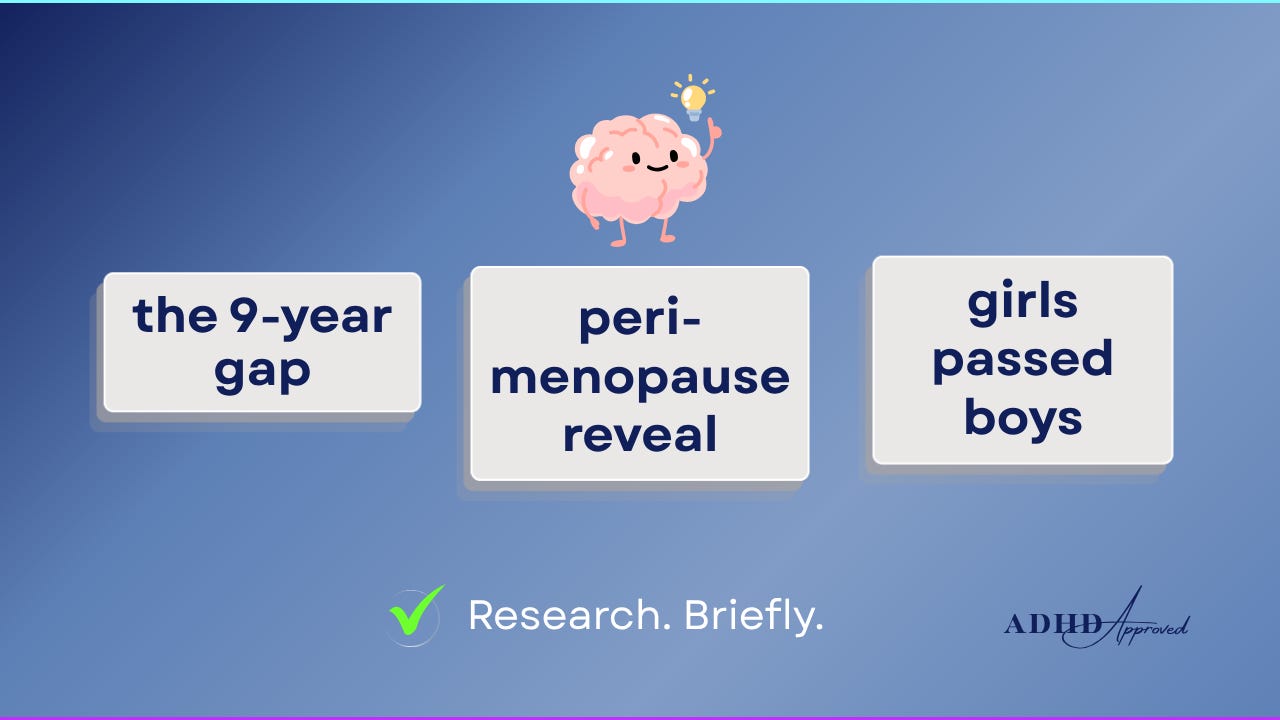
This week’s theme: Women and girls dominated the ADHD conversation, and the field got its first genuinely new medication mechanism in years. Little brand-new peer-reviewed science dropped in the last 7 days, so I’ve led with the two solid this-week items and rounded out with clearly-dated context.
The FDA approved a new-mechanism ADHD drug
The FDA approved centanafadine (brand name Simtriyo) on July 24, a once-daily pill that’s the first of its kind for ADHD. Think of most ADHD meds as turning up two brain signals; this one turns up three (norepinephrine, dopamine, and serotonin), which could help people who don’t tolerate or respond to stimulants. It’s backed by four Phase 3 trials in kids, teens, and adults showing real symptom gains.
Worth knowing because: it’s a freshly launched, heavily marketed drug and the full trial data haven’t been published yet, so temper the hype until the numbers are public.
Primary: Psyciatric Times
Confidence: Watch carefully
Missed ADHD in women carries a steep, hidden health cost
A widely-shared NPR feature pulled together why ADHD in girls slips under the radar: girls tend to look "spacey" rather than disruptive, so they're diagnosed years later than boys, often not until adulthood, after years of being treated for anxiety or depression instead. The stakes are high: a large UK registry study found women with ADHD die on average nearly nine years earlier than peers without it, with elevated rates of obesity, eating disorders, type 2 diabetes, and heart disease.
Worth knowing because: this is the clearest evidence yet that the delay was a system failure.
Primary: The British Journal of Psychiatry, Jan 2025, original mortality study
Plain-English read: NPR, Living Better Series
Confidence: Strong (large matched cohort, ~30,000 adults with ADHD vs 300,000 matched controls)
Not New, Still Relevant
Girls out-diagnosed boys for the first time in a large dataset
Analyzing health records for 2.7 million people in British Columbia, researchers found that after the pandemic, ADHD diagnoses in teen girls and young women passed boys for the first time on record. It's one region's data, so it reflects a diagnosis pattern rather than a true prevalence flip — but it's concrete evidence that the historic "ADHD is a boy thing" gap is closing fast.
Worth knowing because: the wave of late-diagnosed women isn't an anomaly, it's a correction now visible in the data.
Primary: JAMA Network Open
Plain-English read: CHADD, April 8, 2026
Confidence: Moderate (observational)
Midlife isn't new fragility, it's a missing backup
Women with ADHD report more severe perimenopausal symptoms than women without it, and midlife is when many get diagnosed for the first time. When estrogen drops, it pulls dopamine support down with it, so the coping scaffolding that held for decades stops holding. Think losing the guardrails on a road you've driven safely for years.
Worth knowing because: the midlife "falling apart" isn't new fragility, it's an old system losing its hormonal backup.
Primary: European Psychiatry
Confidence: Moderate (population-based cohort, observational)
Know someone who needs this? Forward it.
Hype Watch:
The "estrogen explains, and HRT fixes, your ADHD" midlife narrative
The solid finding is narrow: women with ADHD have a rougher perimenopause. The hype is the jump to "hormones caused your ADHD" and "HRT will fix it." Estrogen clearly modulates symptoms, but the causal and cure claims are running ahead of the evidence.
The Hype: Yahoo Health/FlowSpace, July 2026, The ADHD Diagnosis Women Don’t Get Until Midlife Breaks Them
Anchored narrowly by European Psychiatry
On the horizon
Otsuka says full centanafadine trial results are coming at an upcoming scientific meeting, that’s when we’ll see how the new drug actually stacks up against stimulants.
Also tracking the hormone thread: with perimenopause research heating up and the new ADHD-Her study recruiting women across the lifespan, estrogen’s role in ADHD symptoms is shaping up to be a story to follow.
Study details: CADDRA
Scope note
All items were checked against their reporting source and, where reachable, the underlying journal. Screening tools and cross-sectional designs are flagged because they show associations, not proof of cause. This briefing is informational and not medical advice.
On confidence
Strong = meta-analysis, large longitudinal study, or replicated finding;
Moderate = solid but narrower or observational;
Early = new, small, or preliminary;
Watch carefully = controversial, pregnancy- or treatment-adjacent, or commercially promoted. Each item carries one label.
➤ Browse every briefing
Keep reading
Why ADHD Often Becomes Obvious After Kids

You were fine before. Maybe not perfect. You’ve always been a little scattered, always left things to the last minute, maybe had that nagging feeling you were running on fumes that nobody else could see. But you were fine. You held a job, kept friends, paid bills, got things done. Even took vacations.
Why Everything Feels Harder Than It Should

Your brain works harder at ordinary tasks than most people’s brains do. Not because something is wrong with you. Because the system managing your attention, memory, and emotional regulation runs at a higher cost per task, and it runs out of runway sooner.
Further reading:
ADHD & Sleep | Research Briefing
Connect:
About Me | Bluesky | 🥤 Buy Me A Coffee | Facebook | Instagram | YouTube
The research referenced in this article is intended for informational purposes only and does not constitute medical advice. Always consult a qualified healthcare provider for diagnosis or treatment.